Why Shopping Centres Need to Reconsider Their Entrance Experiences
Shopping centres spend a lot of time thinking about the customer experience, and rightly so. But that experience doesn’t begin at the first storefront; it begins the moment someone walks through the doors.
September 10, 2026
·
7 min
A shopping centre entrance has a difficult job.
It needs to move hundreds, sometimes thousands, of people efficiently between outdoors and indoors while dealing with shopping carts, strollers, wheelchairs, wet shoes, delivery traffic, and whatever the weather decides to throw at it that day.
And in Vancouver, we know what the weather usually decides.
Despite all of that, shopping centre entrances are often treated primarily as transition spaces. Get people through the doors, point them toward the stores, and try not to create a bottleneck along the way.
I think that undersells how important these spaces really are.
The entrance is where customers get their first physical impression of a shopping centre. It’s also where some of the biggest operational challenges begin, particularly around moisture, dirt, safety, and maintenance. When an entrance works well, you barely notice any of this. When it doesn’t, you notice wet floors, dirty tiles, crowded doorways, temporary caution signs, and staff trying to mop around a steady stream of shoppers.
Shopping centres put enormous thought into what happens once customers are inside. It may be time to give the first 30 feet the same attention.
Why Does the Entrance Experience Matter in a Shopping Centre?
A good shopping centre entrance needs to do more than provide access. It should manage the transition from outside to inside while keeping customers moving safely and comfortably.
That means thinking about several things at once: moisture control, flooring, lighting, accessibility, circulation, cleanliness, and the sheer volume of people passing through the doors.
Retail entrances also have a psychological job. Customers should feel like they’ve arrived somewhere clean, organized, and easy to navigate. They shouldn’t have to immediately watch their footing, manoeuvre around a cleaning cart, or figure out which door they’re supposed to use.
The best entrances make that transition feel effortless, but there’s usually a lot happening behind the scenes to make effortless possible.
A condo might have a few hundred residents moving through its main entrance over the course of a day. A busy shopping centre can have thousands of visitors, with traffic surging around lunch, after work, on weekends, and throughout the holiday season.
Every person brings a little bit of the outdoors with them.
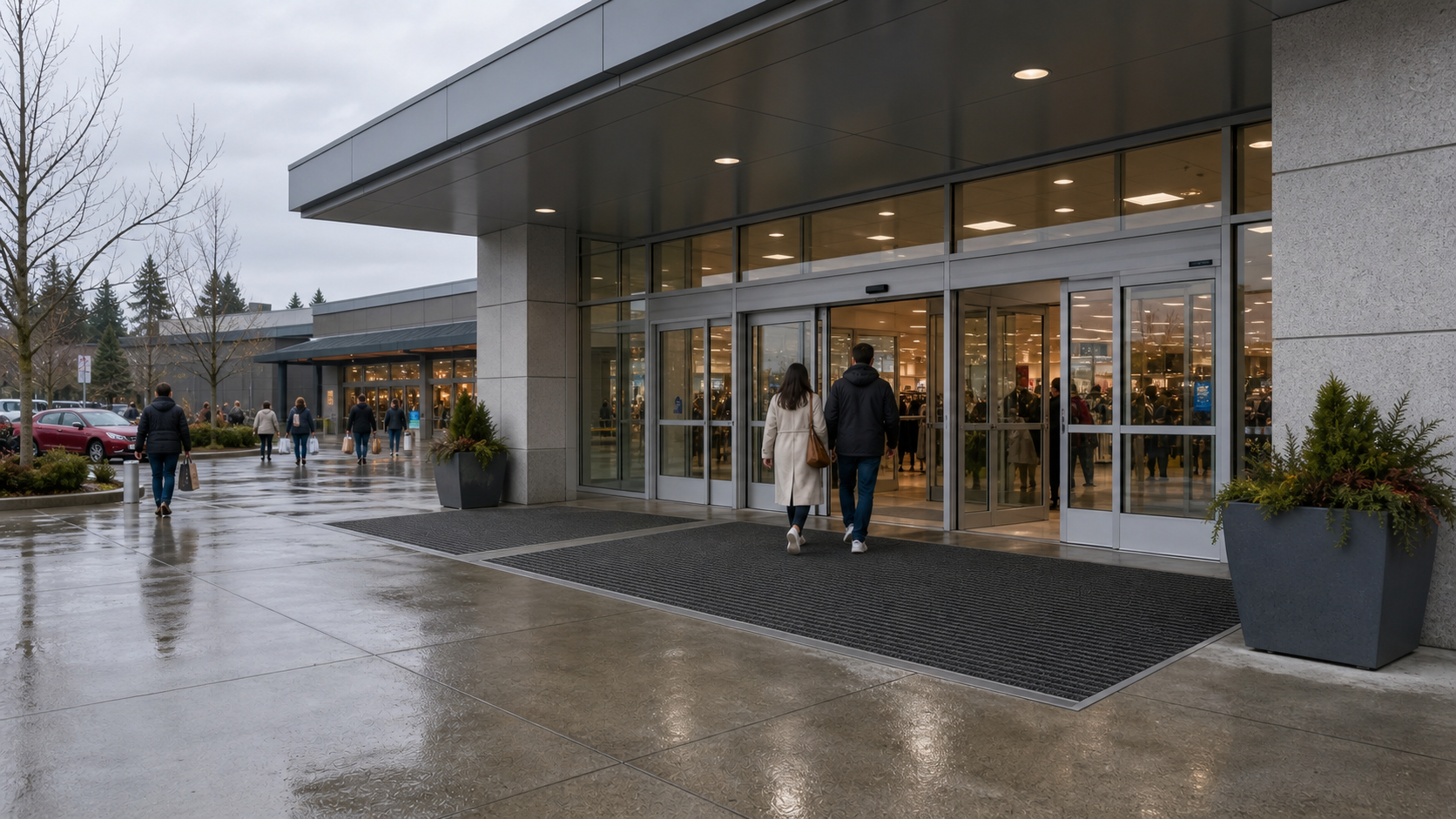
On a rainy Vancouver Saturday, that means wet shoes arriving almost continuously. Add stroller wheels, mobility devices and shopping carts, and moisture can move well beyond the doorway surprisingly quickly.
The entrance system needs to keep up with that volume. A solution that works perfectly well in a small office building may be completely overwhelmed in a major retail environment.
That’s why entrance design needs to start with how the building is actually used rather than simply how the space looks.
How Do You Keep a Shopping Centre Entrance Dry?
The most effective approach is to capture moisture gradually rather than expecting one small mat to do everything.
Ideally, the process starts before customers reach the main flooring. Exterior or vestibule surfaces can begin removing larger debris and moisture, followed by absorbent matting inside that continues drying footwear and wheels over several steps.
Length matters here. If customers take one step on a mat and five wet steps on tile, the system hasn’t really done its job.
Width matters too. People don’t enter shopping centres in neat single-file lines. They arrive side by side, cut across entrances at angles, push carts around slower pedestrians, and choose whichever door looks fastest. Effective matting needs to cover that real movement pattern rather than a narrow theoretical pathway.
Once water escapes the entrance zone, the job becomes much harder. Foot traffic spreads it further into the centre, and cleaning staff are left trying to manage moisture while customers continue walking through it.
It’s much easier to stop water early than chase it later.
Custom Matting Makes Sense in High-Traffic Retail Entrances
This is where custom matting can become particularly useful in commercial applications.
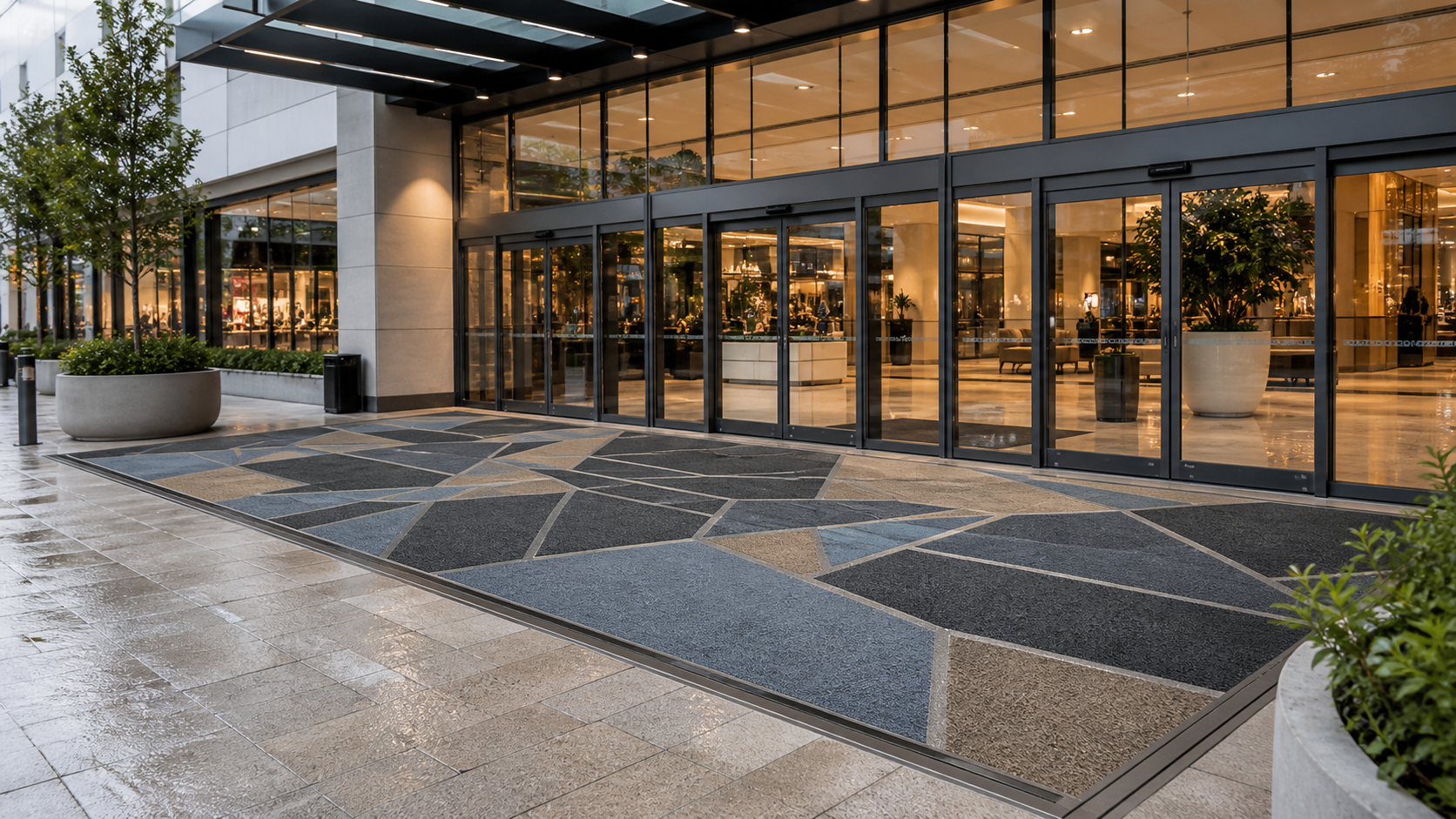
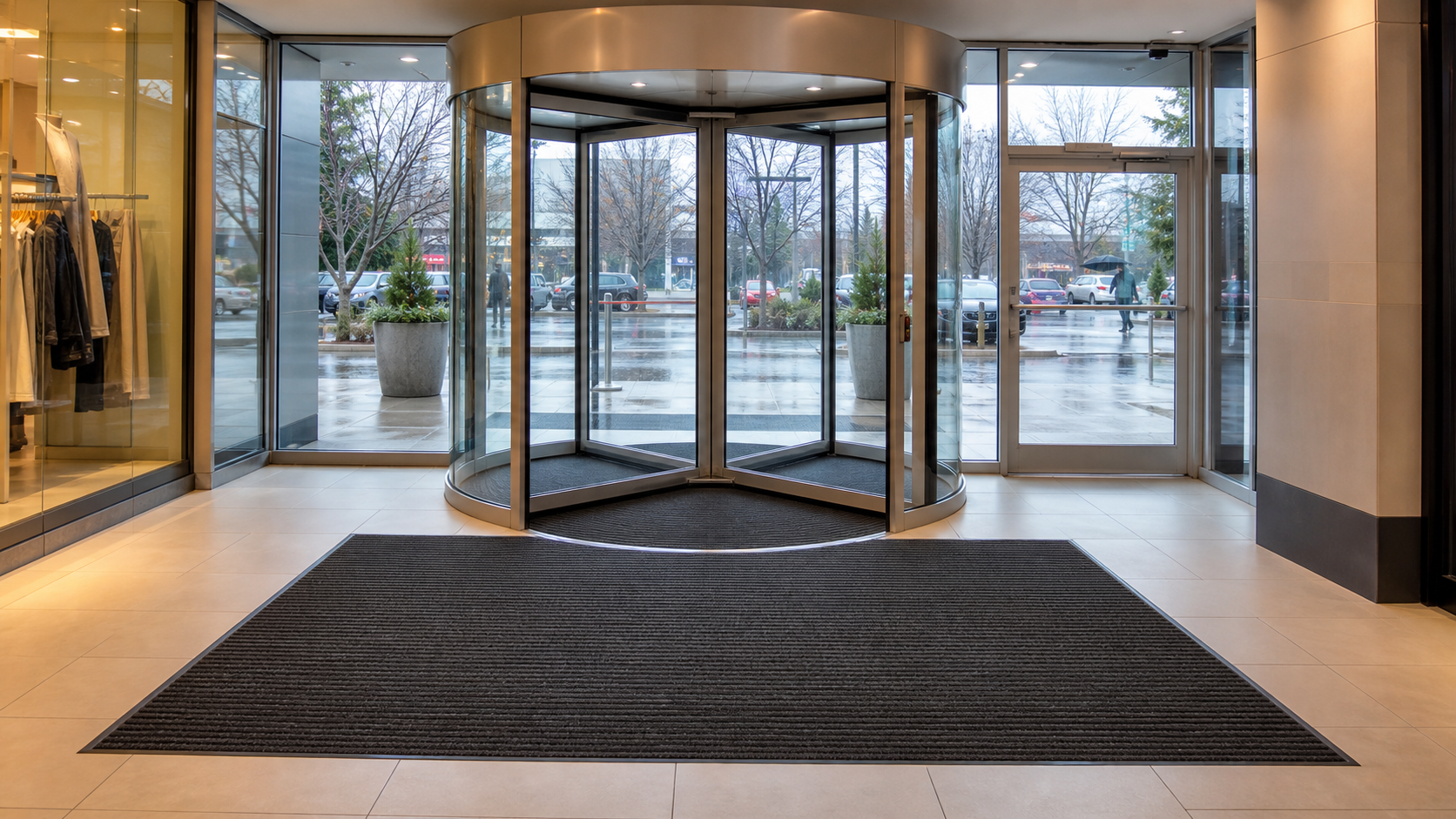
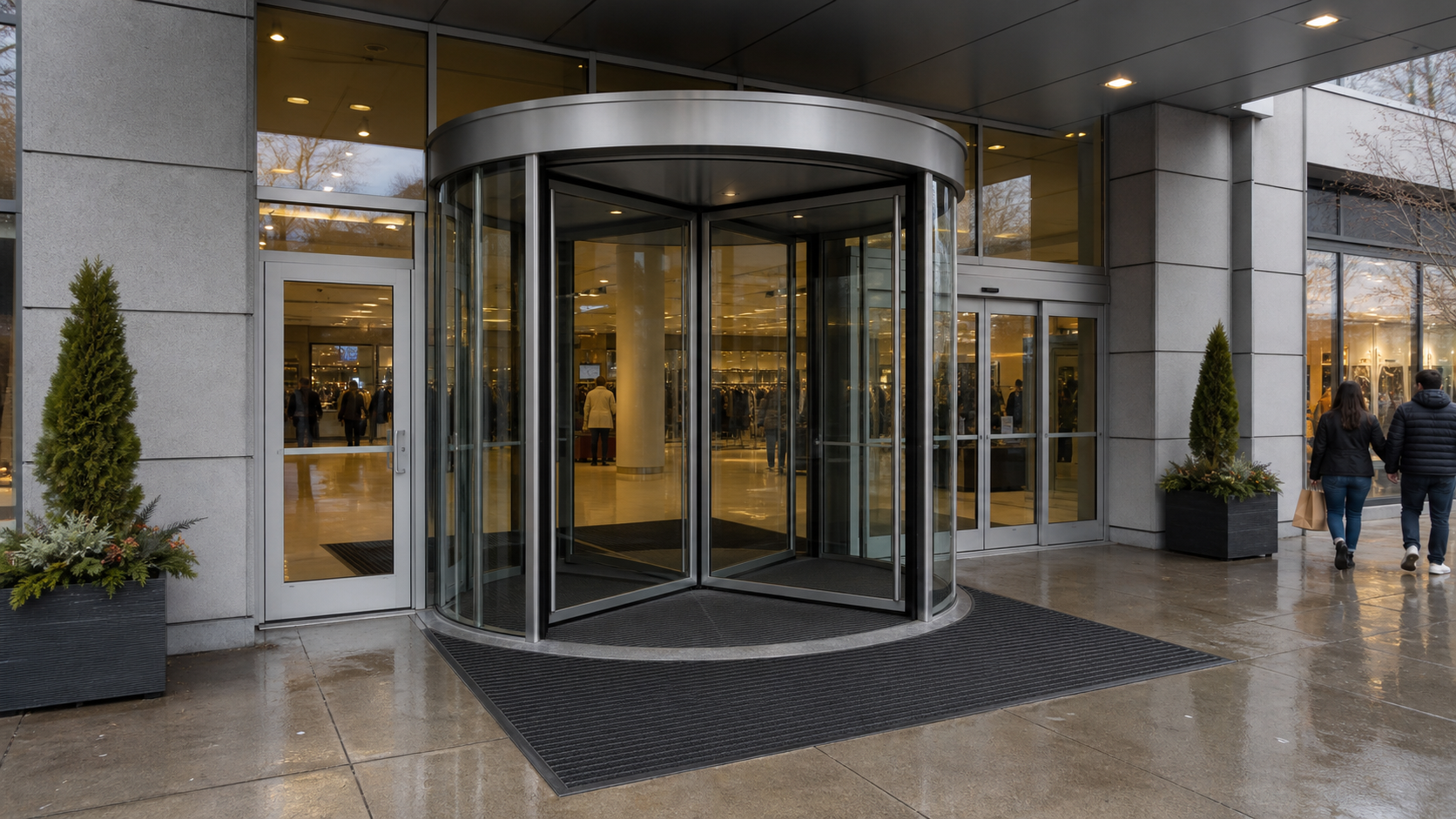
Shopping centre entrances aren’t always nice, simple rectangles. They can be exceptionally wide, include multiple sets of doors, revolving doors, vestibules, columns, angled pathways, and transitions between different flooring materials. Dropping a few standard mats into a space like that can leave gaps exactly where customers naturally walk.
Custom-fitted entrance matting can be designed around the actual dimensions and traffic patterns of the entrance, providing continuous coverage where it’s needed most. It can also feel more intentional visually, rather than looking like something that was added after the flooring started getting wet.
For a high-volume retail property, that matters operationally. More moisture and debris captured at the entrance means less travelling onto finished floors, fewer wet areas for staff to manage, and a cleaner entrance during the busiest parts of the day.
The matting isn’t separate from the entrance design. Done properly, it’s part of it.
Safety and Cleanliness Are Closely Connected
A wet entrance is obviously a potential slipping concern, but there’s another side to the problem: wet entrances also start looking dirty very quickly.
Water mixes with grit and whatever else people have picked up outside, then foot traffic spreads that mixture across the floor. On light-coloured tile, you see every mark. On darker surfaces, you may see less dirt, but that doesn’t mean the moisture has disappeared.
This creates a frustrating cycle for operations teams. Staff clean the area, another rush of customers comes through, and within minutes the floor looks like it needs attention again.
Good entrance design reduces how much cleaning has to compensate for the environment. Cleaning is still essential, of course, but staff should be maintaining a good system rather than constantly rescuing a bad one.
What Flooring Works Best for a Shopping Centre Entrance?
There isn’t one flooring material that works for every shopping centre, but retail entrance flooring needs to balance durability, traction, appearance, and maintainability.
Durability is particularly important because commercial traffic is relentless. Flooring needs to withstand shoes, carts, strollers, grit, moisture, cleaning equipment, and years of repeated use without quickly looking worn.
Traction needs to be considered under real conditions too. A beautiful surface that performs well when dry but becomes noticeably slick when wet is going to create an operational headache at a Vancouver entrance.
The transition between matting and permanent flooring also deserves attention. It should feel smooth and intuitive for pedestrians, wheelchairs, strollers, and carts, without curled edges or awkward changes in elevation.
The best choice is rarely the material that looks most impressive in isolation. It’s the one that still performs well when 2,000 wet people have walked across it.
Key Takeaways: How Can Shopping Centres Improve Their Entrance Experiences?
A better shopping centre entrance starts by treating the space as an important part of the customer experience and an operational system, not simply a set of doors.
Here’s where I would focus:
Manage moisture before it reaches finished floors. Use a staged entrance system that removes dirt and water over multiple steps rather than relying on one small mat.
Use matting that matches real traffic patterns. Custom-fitted matting can provide better coverage across wide, unusual, or extremely busy retail entrances.
Choose flooring for real conditions. Prioritize durability, traction when wet, ease of cleaning, and smooth transitions for carts, strollers, and mobility devices.
Make circulation intuitive. Customers should immediately understand where to enter, where to go, and where they can pause without blocking traffic.
Design for peak volume. Evaluate how the entrance performs during busy weekends, holiday periods, and rainy weather, not just under ideal conditions.
Reduce reliance on temporary fixes. If extra mats, caution signs, and constant mopping are required every time it rains, the underlying entrance system probably needs attention.
Treat cleanliness as part of the experience. Capturing moisture and debris early helps the entrance stay cleaner throughout the day and reduces pressure on maintenance staff.
The goal is a space that keeps people moving comfortably while quietly handling everything they bring through the doors with them.
FAQ: Shopping Centre Entrance Design
Why are entrance mats important in shopping centres?
Entrance mats help remove moisture, dirt, and debris from footwear and wheels before they reach finished flooring. In high-traffic retail environments, adequate matting can also reduce the amount of moisture that cleaning teams need to manage throughout the day.
Is custom matting useful for commercial retail entrances?
Yes, particularly for wide or unusually shaped entrances. Custom matting can cover the actual traffic area more completely than standard-sized mats and can be fitted around architectural features and different entrance configurations.
How can shopping centres reduce slippery floors near entrances?
The first step is controlling moisture with effective entrance matting. Flooring should also provide appropriate traction when wet, and drainage, cleaning procedures, and transitions between surfaces should be reviewed where moisture repeatedly accumulates.
What makes a shopping centre entrance welcoming?
A welcoming entrance is clean, well-lit, easy to navigate, and spacious enough for customers to transition indoors without immediately creating congestion.
How can you tell if a retail entrance needs improvement?
Look at how it performs during peak traffic and bad weather. Repeated wet areas, temporary mats, frequent caution signs, constant mopping, congestion, or confusing movement patterns are all signs that the entrance may not be performing as well as it could.
Shopping centres spend a lot of time thinking about the customer experience, and rightly so. But that experience doesn’t begin at the first storefront; it begins the moment someone walks through the doors.
Get the entrance right, and customers may never consciously notice all the work it’s doing. They’ll simply walk into a space that feels clean, safe, organized, and ready for them.
Making Vancouver buildings just a little bit better... xoxo J.