Why Do Condo Entrances Get Slippery and How Do You Fix It?
Why do condo entrances become slippery, especially in wet conditions? Let's explore the causes, flooring choices, and most importantly water and weather conditions and provide practical solutions to reduce slip risks.
March 9, 2026
·
9 min
If you manage a building in Vancouver, you already know this problem.
Rain. Shoes. Tile. Repeat.
I’ve dealt with this in more buildings than I can count, and it almost always comes back to the same thing. Condo entrances get slippery for a very simple reason that no one really talks about: they’re designed like showrooms and used like mudrooms.
And no one reconciles that gap until it becomes a liability issue, a cleaning problem, or a resident complaint that doesn’t go away.
This is where most buildings get it wrong.
Let’s walk through what’s actually happening—and how to fix it in a way that holds up in a West Coast winter.
The Short Answer
Why do condo entrances get slippery?
It’s pretty simple. Water, snow, dirt, and the elements in general are constantly tracked in from outside, and most lobby materials don’t absorb it. Without enough properly designed matting to capture that moisture, it spreads across hard surfaces and reduces traction.
How do you fix it?
By installing a properly sized, multi-stage entrance system that removes and absorbs water before it reaches the main lobby floor, and designing it around how people actually move through the space. That’s the Coles Notes.
The rest is in the details—and the details are where condo entrances succeed or fail.
Why This Problem Is So Consistent in Vancouver
Vancouver doesn’t overwhelm buildings with extreme weather. It wears them down slowly.
The rain is steady, persistent, and efficient. It doesn’t arrive in dramatic bursts. It shows up in the morning and, as any Vancouverite will tell you, it stays. By the time residents are coming home, everything is evenly damp. Shoes, coats, dogs, stroller wheels, delivery carts, you name it.
Individually, none of that seems like much. But entrances don’t deal with individuals. They deal with volume.
A few hundred small deposits of moisture, arriving over a short window, will outperform almost any entrance that wasn’t designed for it.
No one thinks about this until it becomes a problem.
What Actually Happens at the Door
From an operational perspective, the issue isn’t just water coming in. It’s what happens next.
Most buildings rely on hard finishes at the entrance—tile, stone, polished concrete. These are durable and easy to maintain, which is why they’re used everywhere.
But they don’t absorb moisture. They hold it on the surface until something moves it.
And here’s the thing: something always moves it.
Foot traffic spreads water into a thin, nearly invisible layer. Cleaning staff, trying to stay ahead of it, often make that layer more uniform. What you end up with is a floor that looks clean and controlled but has less grip than it should. The building appears well-run.
Functionally, it’s underperforming in a very basic way.
The Matting Problem (It’s Almost Always This)
If you walk into a building and the entrance is slippery, you don’t need to look far.
It’s usually the mat. More specifically, it’s the size of the mat.
Most entrance mats are designed to fit the space visually. They sit neatly inside the door swing, align with the tile grid, and behave themselves from a design perspective.
On paper, they’re correct.
Operationally, they don’t do enough.
How big should an entrance mat in a condo entrance be?
Long enough for several natural steps.
In practice, that means a person should be able to walk across the mat without breaking stride and still have time to remove moisture from their shoes. If someone steps on it once and then onto tile, it’s undersized.
Most people aren’t adjusting their stride for your flooring strategy. They’re walking in with groceries, holding doors, managing kids or dogs, and trying to get home.
The building needs to meet them where they are. If your mat doesn’t allow for that, it’s decorative.
Vestibules: Present, But Not Always Participating
A lot of buildings technically have vestibules. They just don’t do anything.
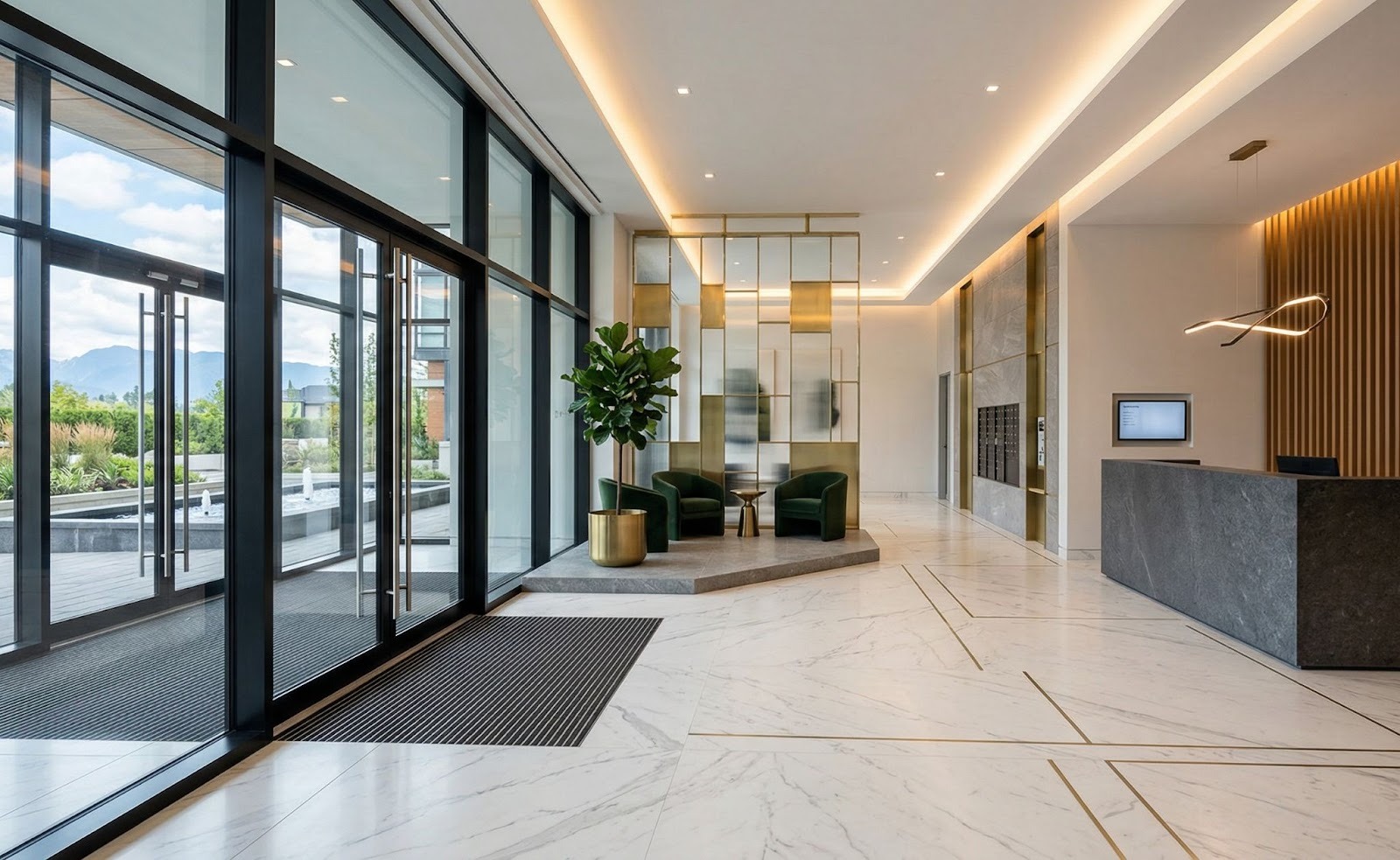
You’ll see exterior doors, a small in-between space, and then the main lobby doors. It checks the box. But the flooring inside that vestibule is often identical to the lobby, or the matting is minimal and undersized.
So instead of acting as a transition zone, it becomes an extension of the problem.
A proper vestibule should absorb most of the incoming moisture. It’s the one place where the building has a real chance to intercept water before it spreads.
When that opportunity is missed, everything downstream becomes harder to manage.
And then the lobby gets blamed.
Cleaning Isn’t a Solution (And Sometimes Makes It Worse)
The instinct is always the same. More cleaning. More mopping. More visible effort.
It helps, but it doesn’t solve the problem. In some cases, it makes it worse.
A damp mop on a busy entrance spreads water more evenly across the surface. Certain cleaning solutions reduce friction temporarily. And during peak traffic, staff are essentially chasing a moving target.
Remember: Cleaning is maintenance, not moisture control.
What Actually Works
Fixing a slippery entrance isn’t about one product. It’s about treating the entrance like a system.
So what actually works in practice?
A staged approach, starting outside the building and continuing through the vestibule
Enough matting depth to allow for multiple natural steps
Full-width coverage that matches how people actually enter and move
Materials that both scrape debris and absorb moisture—not just one or the other
When this sequence is compressed into a single small mat just inside the door, the system collapses.
The other piece is proportion.
Entrances need to be sized for how they’re used, not how they’re drawn. People don’t walk in straight lines. They cut angles, hold doors, and step around each other.
If your matting doesn’t account for that, people will bypass it without thinking.
And once they do, the rest of the system stops working.
The Quiet Role of Transitions
If you’re trying to diagnose a persistent slippery area, look closely at transitions.
Door thresholds, slight changes in elevation, and material shifts are all points where water tends to collect. Even a subtle slope toward the interior can create a consistent line of moisture just inside the entrance.
You’ll often see it as a faint arc or band on the floor, a place that never quite dries, no matter how often it’s cleaned.
These are small details. But in buildings, small details tend to compound over time.
Should You Just Replace the Flooring?
This question comes up more often than it should.
Yes, there are more slip-resistant materials available.And yes, they can help.
But they don’t stop water from entering the building. They just reduce the consequences slightly.
If the entrance system isn’t doing its job, new flooring becomes a partial solution at best. You might reduce complaints, but you won’t eliminate the issue.
It’s the difference between managing risk and removing the cause.
Where Custom Solutions Actually Make Sense
Every building has its quirks.
Door placements, traffic patterns, layout constraints—none of it is perfectly standard. And standard mat sizes don’t always align with those realities.
That’s why so many entrances feel like they’re almost working.
This is usually where custom solutions come into play. Not as an upgrade, but as a correction.
Companies like McCrann Custom Flooring tend to come up in that context—particularly for entrance well mats and longer interior runs that align with real circulation paths, not idealized ones.
It’s less about specification and more about closing the gap between how the building was designed and how it’s actually used.
The Underlying Issue No One Talks About
Entrances are treated as aesthetic features instead of as operational systems.
They handle weather, traffic, first impressions, and a meaningful portion of your building’s liability exposure. And yet they’re often one of the least rigorously designed parts of the building once you move past the visual layer.
That disconnect shows up quickly in a city like Vancouver.
And once it shows up, it tends to stay.
Key Takeaways: How Do You Fix a Slippery Condo Entrance?
If you’re trying to fix a slippery entrance, the answer is usually simpler than it seems, but it has to be done properly.
A working entrance does five things well:
1. It stops water early, before it reaches the main lobby
Add exterior scraping mats and make sure your vestibule is doing real work, not just acting as a pass-through space.
2. It gives people enough steps to remove moisture naturally
Install matting that allows for at least 4–6 full steps. If people step once and hit tile, the system isn’t long enough.
3. It covers how people actually move through the entrance
Extend matting wall-to-wall and along natural walking paths, including angles and side entries, not just straight lines from the door.
4. It uses materials that both scrape and absorb
Combine coarse exterior mats (to remove debris) with absorbent interior mats (to capture moisture). You need both for the system to work.
5. It maintains the system consistently
Replace saturated mats, rotate them during heavy rain periods, and avoid over-mopping, which can spread moisture instead of removing it.
If one of those is missing, the system breaks down. And in Vancouver, it doesn’t take much for that breakdown to show up.
FAQ: Quick Answers for Common Questions About Slippery Condo Entrances
Why do condo entrances get slippery when it rains?
Because water is tracked in continuously and most entrance flooring does not absorb it. Without enough absorbent matting, moisture spreads across the surface and reduces traction.
How long should an entrance mat be?
Long enough for several natural steps. If someone steps on it once and then onto hard flooring, it’s not doing enough.
Do vestibules solve the problem?
Only if they’re designed to. A vestibule without proper matting is just a space between doors.
Can better cleaning fix a slippery entrance?
It helps maintain the space, but it doesn’t address the volume of water entering the building.
What can you do to fix a slippery condo entrance?
Stop water early, give people enough steps to remove moisture, cover how people actually navigate the entrance, use materials that both scrape and absorb, and don’t skimp on maintenance.
So that’s it. A simple rundown of why condo entrances get slippery, and what you can do to fix the problem. I hope you stay dry out there, or maybe more importantly in the context of this article, stay dry in there, too.
Making Vancouver buildings just a little bit better... xoxo J.